The hospitality industry is in the middle of a sustainability reckoning. Regulations are tightening. Guests are paying attention. And hotels are scrambling to prove they take it seriously.
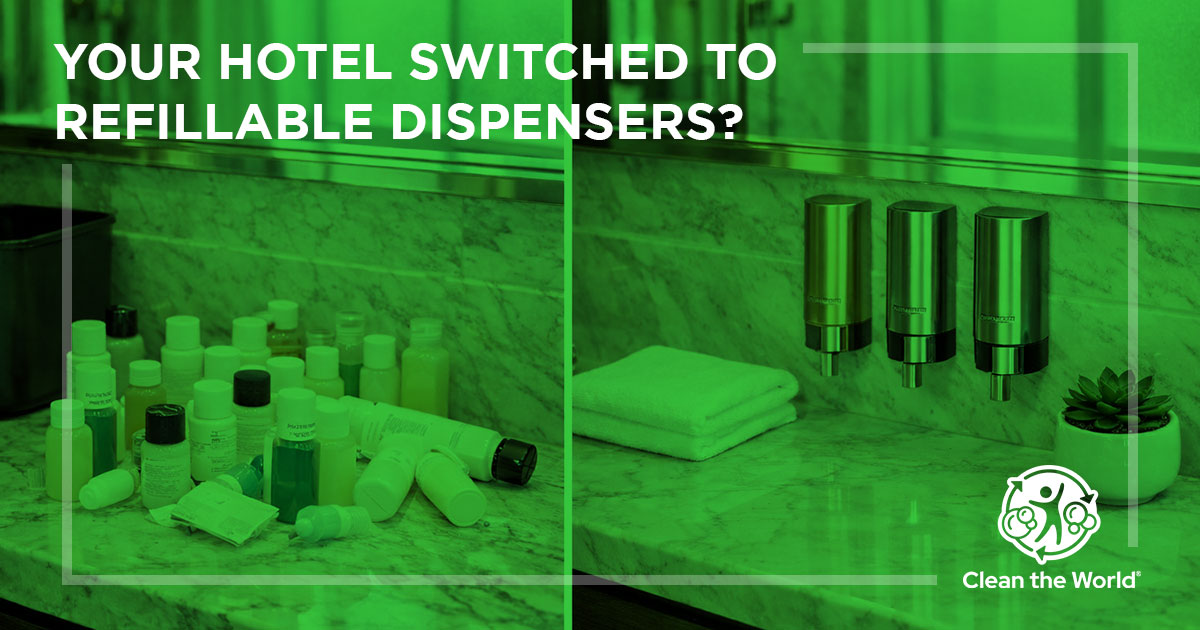
For many, the answer has been simple: swap out single-use toiletries for wall-mounted refillable dispensers.
It makes sense. Fewer tiny bottles. Less visible waste. A stronger sustainability story to tell.
But for hotels looking to go further, the dispenser switch is a starting point — not the finish line.
The Dispenser Shift Is Happening Fast
Refillable dispensers have gone from trend to mandate in just a few years. New York State banned small plastic hospitality bottles effective January 2025 for hotels with 50+ rooms, expanding to all hotels by January 2026. The EU has set targets to phase out many single-use plastics by 2030. Radisson Hotel Group has committed to reusable soap dispensers across its entire portfolio, estimating the move will eliminate 57 million miniature bottles annually.
The push is clear: single-use plastic toiletries are on their way out. And for good reason — the average hotel guest uses at least 2–3 single-use plastic items per night, and globally, the hospitality industry generates over 1.9 million tonnes of waste annually.
Dispensers directly address this. But they don’t address all of it.
The Next Opportunities Most Hotels Haven't Tackled Yet
At HOSPACE 2025, conversations with hotel sustainability leaders revealed a shared challenge: even after making the switch to refillable systems, there are still waste streams that need attention. That’s not a failure, it’s an opportunity.
Bulk refill containers are still plastic
Wall-mounted dispensers are great at eliminating the tiny bottles guests see. The next piece of the puzzle is what happens behind the scenes. Housekeeping teams refill dispensers from larger plastic containers, jerry cans, multi-liter bottles, that also need responsible disposal. Hotels that account for this back-of-house waste alongside their guest-facing efforts are telling a much more complete sustainability story.
Half-full dispensers get thrown away
Operational realities add another layer. Industry guidelines recommend replacing refillable dispenser units every 6-12 months, and in fast-paced housekeeping environments, partially used refill bottles sometimes get discarded during changeovers. Hospitality Net reported in 2026 that dispensers deliver the strongest sustainability outcomes when paired with strong operational systems behind them. The hotels seeing the best results are the ones that plan for this from the start.
Bar soap still ends up in the trash
Most hotels that have transitioned to dispensers for shampoo, conditioner, and body wash still offer bar soap at the sink or in the shower. Those partially used bars are discarded after each checkout, and they represent a meaningful opportunity. Recycling those bars extends the impact of a hotel’s existing sustainability investment.
The waste that already exists doesn’t go away
For properties still mid-transition, or those that have already made the switch, there’s also the question of ongoing waste from the amenities still in circulation. Addressing this alongside the dispenser rollout creates a more comprehensive approach.
Turning a Good Decision Into a Great Story
Switching to dispensers is a strong operational move. The next step is turning that move into a measurable, communicable impact story.
Guests and stakeholders increasingly want to see proof behind sustainability efforts. Eco-conscious travelers expect visible commitments, and those expectations directly impact bookings and reviews. The hotels that stand out aren’t just the ones making changes, they’re the ones that can quantify them.
How much waste was diverted? What was the measurable impact on carbon emissions or water use? How did the community benefit?
These are the questions that turn a smart infrastructure decision into a competitive advantage.
Building a Complete Strategy
The strongest hospitality sustainability programs layer multiple approaches together. Refillable dispensers handle one important piece. A recycling and impact measurement program handles the rest:
- Partially used bar soap that still gets discarded at checkout
- Bulk plastic refill containers used behind the scenes
- Bottled amenities from properties still transitioning
- Dispenser units themselves when they reach end of life
Clean the World’s Hospitality Recycling Program works with more than 8,600 hotel partners worldwide to divert discarded soap and bottled amenity waste from landfill. But the recycling is only part of the value. Every kilogram of collected material gets tracked through a Greenview-verified Impact Reporting System that transforms waste data into actionable ESG metrics, tracking soap diversion, plastic diversion, water savings, and CO₂e reductions.
This is the piece most hotels are missing. Dispensers reduce inputs. A recycling and reporting program addresses outputs, and gives hotels the verified data they need for ESG compliance, investor reporting, and credible guest-facing sustainability claims.
A Real-World Example: Conservatorium Hotel, Amsterdam
The Conservatorium Hotel in Amsterdam has partnered with Clean the World since 2018, demonstrating what a comprehensive approach looks like in practice.
Over seven years, the five-star property has:
- Collected 2,756 kg of soap and 4,499 kg of bottled amenities
- Distributed 41,340 recycled soap bars to communities in need
- Saved 76,588 litres of water
- Reduced 3,762 kg of CO₂e emissions
“I am proud to see our colleagues feel empowered to contribute as we have managed to recycle a vast amount of soap bars and guest amenities over the past few years,” said Anna Kusma, Executive Housekeeper at the Conservatorium Hotel.
These aren’t estimated projections. They’re verified outcomes. The kind of data that holds up in an ESG report, on a sustainability page, or in a conversation with an investor.
The Real Question for Hotels
The shift to refillable dispensers is a good step. It reduces a meaningful category of single-use waste. But it was never meant to be the whole strategy.
The most forward-thinking hotels are the ones asking one more question after making the switch:
How do we build on this momentum?
That question is what turns a smart operational decision into a full sustainability strategy. One that resonates with guests, satisfies stakeholders, and creates real impact beyond the property walls.
Interested in learning how Clean the World can support your hotel’s sustainability goals? Visit cleantheworld.org/partners to explore the Global Hospitality Recycling Program.