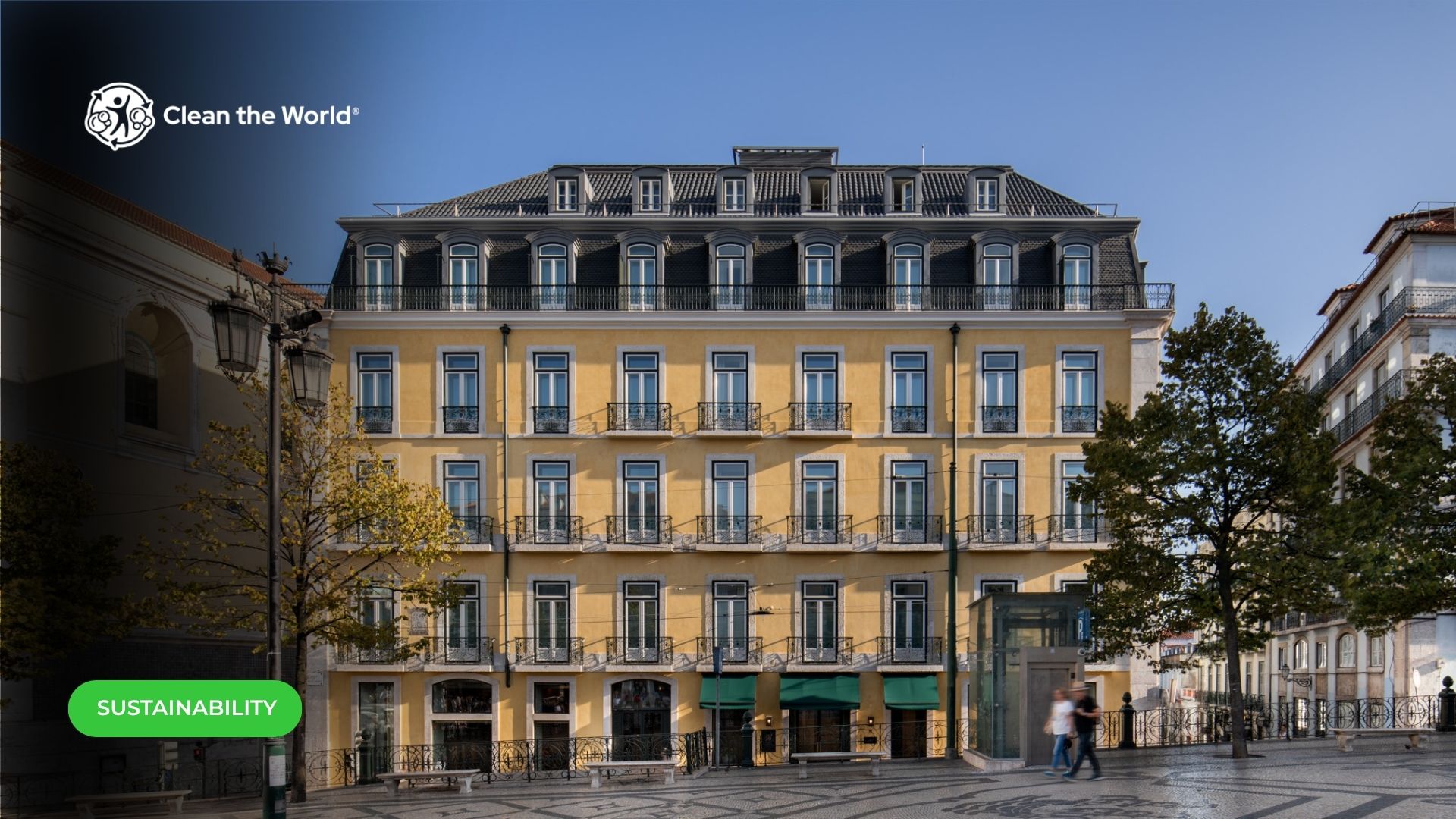
Image above, Bairro Alto Hotel, Lisbon
Across Europe, some of hospitality’s most recognised hotels are turning sustainability commitments into practical action.
Through Clean the World’s partnerships with more than 8,600 hospitality partners worldwide, we see first-hand how hotels are approaching sustainability inside everyday operations. [1]
There is no single initiative that makes a hotel sustainable. Energy, emissions, water, food, procurement, waste and supply chains all matter.
But looking across the hotels we work with reveals something interesting.
Leading properties are becoming more specific about the materials moving through their operations. They are giving teams clearer processes, measuring the results and connecting individual initiatives to wider sustainability strategies.
Bathroom amenities are one example.
Through Clean the World’s Global Hospitality Recycling Program, eligible discarded soap and plastic bathroom amenities can be separately collected for responsible processing, while participating hotels gain measurable information about the materials collected. [1]
From Barcelona and Amsterdam to Lisbon, Munich and Manchester, here is what that looks like in practice.
Hilton Diagonal Mar Barcelona: Making Everyday Operations Measurable
At the 433-room Hilton Diagonal Mar Barcelona, bathroom amenity collection has become part of everyday hotel operations.
As of April 2025, the property had collected:
- 265 kg of soap
- 4,630 kg of plastic bottled amenities
- 4,895 kg of material in total
Its soap participation had also contributed to the distribution of 3,113 recycled soap bars and reported water savings of 7,363 litres associated with the soap recycling process. [2]
The lesson is simple.
Sustainability becomes more tangible when an operational activity can be implemented consistently and its results can be measured.
For a hotel, that means turning something that might otherwise disappear into a general waste stream into information the business can actually see.
THE PIG Hotels: Solving a Simple Operational Problem
Not every sustainability improvement begins with a major infrastructure project.
Sometimes it starts with noticing something that does not make sense.
THE PIG Hotels had already taken steps to reconsider the amenities provided to guests, but partially used soap bars were still being discarded.
That created a straightforward question: could those bars be managed differently?
Through Clean the World, eligible used soap is now collected for recycling.
Kate Harvey, Group Sustainability Manager at THE PIG Hotels, explains:
“It still felt wrong discarding hundreds of soap bars every day. That’s why we teamed up with Clean the World to recycle our soap, preventing it ending up as waste and giving it a new lease of life, supporting worldwide communities vulnerable to hygiene-related illnesses.” [3]
It is a useful reminder that meaningful operational progress can begin with something very specific.
Identify the problem. Put a better process around it. Measure what happens next.
PPHE Hotel Group: What Happens When the Approach Scales
The opportunity becomes even more interesting when the same process is implemented across a portfolio.
PPHE Hotel Group joined Clean the World’s Global Hospitality Recycling Program in November 2024.
By June 2026:
- 17 hotels were participating across the UK and the Netherlands
- 5,149 guest rooms were covered
- 25,777 kg of plastic bathroom amenities had been collected and diverted from landfill. [5]
But the value for PPHE goes beyond the volume collected.
Alex Matulina, ESG Manager at PPHE Hotel Group, explains:
“The data gathered through the Clean the World platform is monitored on a quarterly basis and at the end of the year feeds into PPHE’s annual ESG report. Regular monitoring is also useful to understand how properties are performing in terms of recycling activities.” [5]
This is where individual hotel action starts to become portfolio intelligence.
A property can understand its own participation, while central sustainability teams gain visibility across multiple hotels.
For hotel groups, that matters.
The question is no longer simply whether a sustainability initiative works in one property. It is whether it can be implemented consistently, measured and understood across an entire portfolio.
Bairro Alto Hotel: Thinking Beyond the Product Itself
Hotel amenity strategies are changing.
Many properties are moving away from miniature toiletry formats towards larger dispensers and other alternatives.
But changing the product does not remove the end-of-life question.
Larger dispensers eventually need replacing too.
At Bairro Alto Hotel in Lisbon, the 87-room boutique hotel joined Clean the World in late 2023 and collected 217 kg of plastic amenity material in just over one full year. [6]
The property views sustainability as a longer-term journey rather than an isolated project.
That reflects an important shift in thinking.
For procurement and sustainability teams, the question is increasingly not only:
What should we buy?
It is also:
What happens to it when we have finished using it?
That lifecycle perspective is becoming increasingly relevant as hotel groups review amenity formats and packaging choices.
Radisson Hotel Manchester City Centre: One Part of a Much Bigger Strategy
Radisson Hotel Manchester City Centre demonstrates why individual initiatives need to be understood in context.
The 252-room property became the UK’s first Verified Net Zero hotel, with Clean the World supporting the management of its in-room plastic bathroom amenities as one component of a much broader environmental strategy. [7]
Amenity management does not make a hotel Net Zero.
Radisson’s wider approach extends across greenhouse gas emissions, energy, food, procurement, operations and other areas of its value chain. [7]
That is exactly why the example is useful.
Strong sustainability strategies are rarely built around one programme.
They are built from multiple actions, each addressing a specific part of the operation.
Bathroom amenity waste is one of those parts.
Hotel Vier Jahreszeiten Kempinski Munich: Luxury and Measurable Impact
At Hotel Vier Jahreszeiten Kempinski Munich, the 305-room property had reported the collection of:
- 677 kg of soap
- 4,271 kg of plastic bottled amenities
- 4,948 kg of participating material in total
- 18,802 litres of reported water savings associated with its soap recycling activity. [8]
Its work with Clean the World sits alongside wider environmental initiatives at the hotel.
The example helps challenge the idea that sustainability and luxury hospitality sit in separate conversations.
Increasingly, leading luxury properties are looking at the operational detail behind the guest experience as well as the experience itself.
A Real-World Example: Conservatorium Hotel, Amsterdam
The Conservatorium Hotel in Amsterdam (now Mandarin Oriental Conservatorium, Amsterdam) has partnered with Clean the World since 2018, demonstrating what long-term participation can achieve in practice.
As of April 2024, the five-star property had:
Collected 5,640 kg of material, including 2,307 kg of soap and 3,333 kg of plastic bottled amenities
Supported more than 4,790 people
Contributed to the distribution of 41,210 bars of recycled soap
Reported a 3,153 kg CO₂e carbon footprint reduction
Conserved 64,140 litres of water
Supported 521 hygiene kit builds
Anna Kusma, Executive Housekeeper at the Conservatorium Hotel, said:
“I am proud to see our colleagues feel empowered to contribute as we have managed to recycle a vast amount of soap bars and guest amenities over the past few years”.
The figures provide a snapshot of the hotel’s impact as of April 2024 and demonstrate how consistent participation over time can turn an everyday operational waste stream into measurable environmental and social impact.
It also shows the wider value of giving hotel teams a structured process, tracking the results and connecting property-level action to broader sustainability ambitions.
So What Are These Hotels Doing Differently?
The hotels above are very different.
They include independent luxury properties, international brands and multi-property hotel groups across several European markets.
But common themes emerge.
They are:
- Identifying specific operational material streams
- Giving hotel teams a clear process for managing them
- Measuring the results
- Connecting operational activity with wider sustainability reporting
- Considering what happens to products after use
- Looking for approaches that can work across multiple properties
- Treating individual sustainability initiatives as part of a much larger strategy
Perhaps most importantly, they are making sustainability increasingly practical.
This is not about presenting bathroom amenity recycling as the answer to hotel sustainability.
It is about recognising that ambitious sustainability strategies ultimately have to translate into thousands of individual operational decisions.
Bathroom amenities simply give us one clear example of what that looks like.
A New Layer of Hospitality Sustainability
There is also a bigger opportunity emerging.
Hotels already collect large amounts of environmental information across energy, water, emissions and waste.
But individual material streams can still be difficult to see.
Bathroom amenities are a good example.
Once soap or packaging leaves a guest room, understanding exactly what happens to it can become difficult unless a specific process exists to capture that information.
Clean the World provides that additional layer of visibility for eligible bathroom amenity materials.
It does not provide a picture of all hotel waste.
But it can help make one recurring operational waste stream more visible, structured and measurable.
That matters because better sustainability information does not always come from one enormous dataset.
Sometimes the picture becomes clearer stream by stream.
What Can Other Hotels Take From These Examples?
The question for hotel leaders is not whether they need another sustainability initiative.
A more useful question is:
Which parts of our existing operations could we understand and manage better?
That could mean looking at procurement.
It could mean reviewing an overlooked waste stream.
It could mean improving property-level measurement.
Or it could mean asking whether an approach that works in one hotel could be implemented consistently across an entire portfolio.
Across Europe, hotels are already putting these ideas into practice.
For those that have not yet examined bathroom amenity waste in this way, the examples above show what is possible.
Frequently Asked Questions
What Are Leading European Hotels Doing Differently on Sustainability?
Leading hotels are increasingly embedding sustainability into everyday operations, measuring specific material streams, engaging operational teams and connecting individual initiatives to wider environmental and ESG strategies.
How Can Hotels Manage Used Bathroom Amenities?
Hotels participating in Clean the World’s Global Hospitality Recycling Program separately collect eligible discarded soap and plastic bathroom amenities for responsible processing. [1]
What Happens to Used Hotel Soap?
Eligible soap collected through Clean the World is processed and manufactured into new bars of soap for distribution through hygiene programmes supporting communities in need. [1]
Can Hotel Groups Measure Bathroom Amenity Waste Across Multiple Properties?
Clean the World provides programme reporting relating to eligible bathroom amenity material collected. PPHE Hotel Group, for example, monitors its Clean the World data quarterly and uses it within its annual ESG reporting. [5]
Does Amenity Recycling Make a Hotel Sustainable?
No. Bathroom amenity management is one component of a much broader sustainability strategy that can also include greenhouse gas emissions, energy, water, food, procurement, transport, waste and supply chains.
See What Leading Hotels Are Already Doing
Hilton, PPHE Hotel Group, THE PIG Hotels, Radisson, Kempinski, Conservatorium Hotel and Bairro Alto Hotel are among the properties already demonstrating how bathroom amenity waste can become a more visible and measurable part of hotel operations.
Explore the case studies above to see how different hotels are putting the approach into practice.
Or find out how Clean the World’s Global Hospitality Recycling Program could support your own hotel or portfolio.
Sources
[1] Clean the World, Global Hospitality Recycling Program
https://cleantheworld.org/recycling/
[2] Clean the World, Hilton Diagonal Mar Barcelona
https://cleantheworld.org/blog/hilton-diagonal-mar-barcelona-sustainability-clean-the-world/
[3] Clean the World, THE PIG Hotels
https://cleantheworld.org/blog/hospitality-recycling-program-teams-up-with-the-pig-hotels/
[4] Clean the World, Conservatorium Hotel, Amsterdam
https://cleantheworld.org/blog/partner-showcase-europe-conservatorium-hotel-amsterdam-long-term-clean-the-world-partner-and-example-of-modern-day-hospitality/
[5] Clean the World, PPHE Hotel Group
https://cleantheworld.org/blog/pphe-hotel-group-amenity-waste-esg-impact/
[6] Clean the World, Bairro Alto Hotel, Lisbon
https://cleantheworld.org/blog/bairro-alto-hotel-lisbon-sustainability-clean-the-world/
[7] Clean the World, Radisson Hotel Manchester City Centre
https://cleantheworld.org/blog/radisson-to-support-the-uks-first-verified-net-zero-hotel/
[8] Clean the World, Hotel Vier Jahreszeiten Kempinski Munich
https://cleantheworld.org/blog/case-study-hotel-vier-jahreszeiten-kempinski-munich/